How to read a stablecoin reserve report yourself
"Is it actually backed?" is a question the internet will always answer for you, loudly and from both directions. Meanwhile all three major issuers publish the underlying reports on their own websites — no account, no paywall, no request form.
Finding them was never the hard part. The hard part is that most of an attestation is scope language and standard notes, and only four fields actually determine what you should conclude. This page covers where the reports live, which four lines to read, and the one number almost everybody reads backwards.
If you want the background on the USDT reserve argument itself — including the settlement history behind it — start with what is really in Tether's reserves. This page is the mechanical version: where, what, and what not to be misled by.
Three different documents get called "the reserve report"
People use the phrase for three things that carry very different weight. Mixing them up is how most reserve arguments go wrong before they start.
| Document | What it answers | Who, and how often |
|---|---|---|
| Reserve breakdown page | What is in circulation right now and roughly what backs it | The issuer itself, updated continuously |
| Attestation | Whether assets covered liabilities on one specific date | An independent accounting firm, monthly or quarterly |
| Financial statement audit | Whether a full year's financial statements are fairly presented | An independent accounting firm, annually — and not every issuer has one |
The first is self-reported and convenient. The second is what this industry actually runs on. The third was effectively absent from stablecoins until 2026, when the largest of them published its first. Assurance increases down that list — but none of the three tells you anything about tomorrow, which is the point of section four.
The three official pages
For the three fiat-backed coins this site covers, everything is on the issuer's own domain, generally under "transparency":
| Coin | Official transparency page | Attestation firm |
|---|---|---|
| USDT Tether | the transparency section of tether.to (split into Current Balances and Reports & Reserves) | BDO |
| USDC Circle | circle.com/transparency (with a month-by-month report archive) | Deloitte & Touche LLP * |
| FDUSD First Digital | the transparency section of firstdigitallabs.com | Prescient Assurance * |
None of these require signing in. Checking them on 30 August 2026, we could read the Tether and Circle pages and their report archives directly; the First Digital page refused our automated checking tool, so we confirmed the section exists but did not read the current figures from it — open that one in a browser and read it yourself. Issuers, firms and URLs all change, so where this page and the official site disagree, the official site wins.
* The two starred names come from public sources rather than from the pages themselves: on the verification date Circle's transparency page stated only that a Big Four firm performs the monthly assurance, without naming it, and we could not open the First Digital page at all — its attestation firm and monthly cadence are public-source claims too. Treat what those pages say as authoritative.
Circle has one extra layer worth knowing about. USDC reserves sit largely in a government money market fund called the Circle Reserve Fund (ticker USDXX), managed by BlackRock, whose holdings are disclosed daily and linked straight from Circle's transparency page. That means USDC reserves can be followed all the way to that fund's daily published holdings — the concrete reason it gets described as the more transparent option. The comparison is in what USDC is and whether it's more transparent than USDT.
Reserve screenshots doing the rounds on social media almost always lose two things: the as-of date and the report type. "Reserves exceed liabilities by X billion" means something completely different depending on whether it came from an annual audit or last quarter's attestation, and whether the date is last December or last month. The originals are two clicks away.
Once it's open, read these four fields
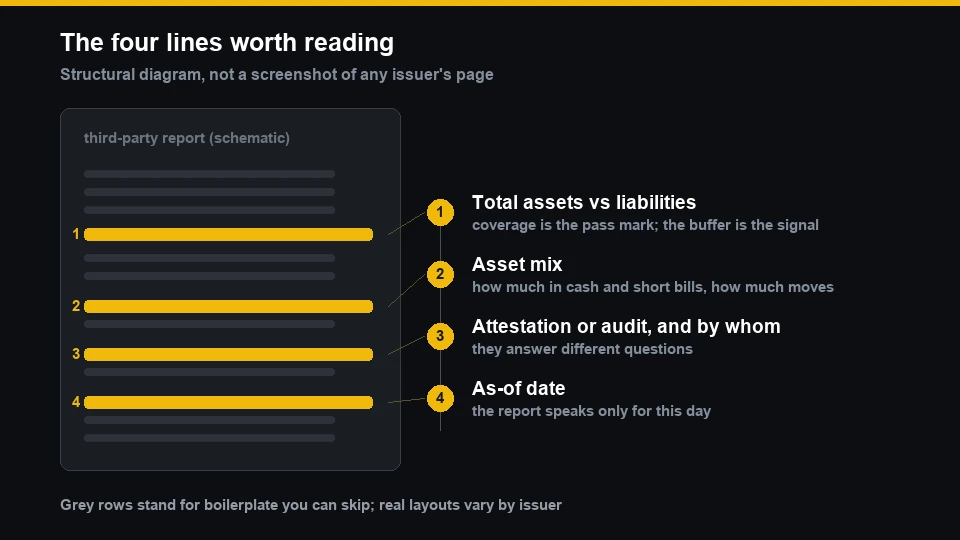
Skip the scope paragraphs. Find these four lines.
1. Total assets against total liabilities
The baseline question: do the reserves cover the tokens outstanding? Take Tether's quarterly attestation published on 31 July 2026: as of 30 June 2026, total assets were US$187.75 billion against total liabilities of US$183.64 billion, leaving roughly US$4.11 billion — the figure usually called excess reserves, or the buffer. Coverage is a pass mark, not a distinction. What carries information is how thick the buffer is and which way it has been moving across recent reports.
2. How much of the mix is the useful kind
Covered is not the same as resilient. Under genuine redemption pressure, what converts immediately is cash and short-dated government paper. In Tether's attestation as of 31 March 2026, US Treasuries accounted for roughly US$141 billion, alongside about US$20 billion in physical gold and about US$7 billion in bitcoin. (That is the previous quarter on purpose: the newer Q2 announcement gives totals and a gold tonnage but not the same breakdown. When you check, use the breakdown in the current report.)
Gold and bitcoin are real assets, but they behave differently from cash and short bills: they carry their own price risk, and it usually bites hardest exactly when markets are stressed. Work out the low-volatility, high-liquidity share separately instead of reading the headline total.
3. Attestation or audit, and whose name is on it
Go to the signature page. An attestation is worded as a limited-scope check of a statement of assets and liabilities at a specified date; an audit report states an opinion on financial statements for a period. The firm's name matters too — an international firm and one nobody has heard of are not equivalent signals.
4. The as-of date
The least glamorous field and the one people skip. A report speaks for its as-of date, not for the day you happen to read it. That deserves its own section.
The number people read backwards
On 13 August 2026, Tether announced that KPMG U.S. had issued an unqualified opinion on the financial statements of Tether International, S.A. de C.V. for the year ended 31 December 2025 — the most positive opinion an independent auditor can give, and the first full financial statement audit in the coin's history. The same announcement noted reserves exceeding liabilities by about US$6.814 billion as of that date.
Now the other document: the same issuer's quarterly attestation, published 31 July 2026, put that buffer at roughly US$4.11 billion as of 30 June 2026.
Both numbers are official and both are correct. Their as-of dates are six months apart and they come from different kinds of report — one an annual financial statement audit, the other a quarterly attestation — but they measure the same thing: how far reserves exceed liabilities. Over those six months the buffer fell about 40%. Anyone who saw the August headline about a KPMG audit and a $6.8 billion cushion and stopped there walked away holding last December's picture, not the most recently disclosed one.
An unqualified opinion says the financial statements for the audited period present the position fairly. It is not an endorsement of the business, not a promise about future solvency, and not automatic compliance with any jurisdiction's rules for issuing a stablecoin — reserve composition, licensing and reporting requirements differ by regime and are a separate set of tests. Treating "audited" as "settled forever" is the most common way this genuinely good news gets misused.
One more detail worth carrying: the audit covers the financial statements of the issuing entity, Tether International, S.A. de C.V., rather than opening every asset of the wider group to public view, and the full audit report was not published at the time of the announcement. That does not make it hollow — moving from attestations only to an unqualified Big Four opinion is a real step up. It just means the certainty available to you went up a level, not to infinity.
Attestation vs audit, after August 2026
The distinction is the foundation of every serious reserve discussion:
| Dimension | Attestation | Audit |
|---|---|---|
| Looks at | Assets and liabilities on one date | Financial statements for a full period |
| Answers | Were the assets there that day | Are the year's statements fairly presented |
| Depth | Limited-scope procedures | Deeper, with substantive testing |
| Cadence | Monthly or quarterly | Annual |
For years, "USDT has attestations but no audit" was a fair criticism. After August 2026 the accurate version is longer: USDT now has an annual financial statement audit, while what gets refreshed each quarter is still an attestation. What Circle and First Digital publish monthly also remains attestation-class reporting, per their own descriptions.
Which means that even in the best case available today, the most recent independent check you can read is a quarterly or monthly attestation. The audit adds a sturdier annual anchor to that timeline. It does not replace it.
A three-minute check
Next time an argument about some coin's backing shows up in your feed, run this instead:
- Open the issuer's transparency page. Not a repost.
- Find the most recent independent report and write down the as-of date and the firm.
- Check total assets against total liabilities; note the buffer.
- Check the mix: how much in cash and short-dated government paper, how much in assets that move.
- Open the previous report and compare — the trend tells you more than any single snapshot.
- Confirm whether you are holding an attestation or an audit, and don't quote one as if it were the other.
Once that becomes routine, your basis for judgement shifts from who said it to what the document says. To skip the step of hunting for entry points, we keep the issuer and audit sources collected in the issuer & audit lookup; for a side-by-side of reserves and disclosure across the three coins, use the stablecoin comparison.
To be clear about scope: this page predicts nothing about any issuer and is not investment advice. Reserve data changes constantly, every figure here describes its own as-of date, and the current official report always supersedes what you read here. There is also a limit most holders never notice — the 1:1 redemption those reports are built around is not something a retail holder can actually use. That one gets its own page: can you actually redeem 1 USDT for $1?
Primary sources and verification date
Checked 30 August 2026. Every figure below belongs to its own as-of date and may since have changed:
- Tether transparency section (Current Balances / Reports & Reserves)
- Tether: Q2 2026 attestation and reserve figures (published 31 July 2026, as of 30 June 2026)
- Tether: KPMG U.S. unqualified opinion on the 2025 financial statements (published 13 August 2026)
- Circle: USDC transparency and monthly attestation archive (states that a Big Four firm performs the monthly assurance, that reserve holdings are disclosed weekly, and links to daily holdings for the BlackRock-managed Circle Reserve Fund)
- First Digital: FDUSD transparency section (refused our automated check on the verification date; section confirmed to exist, figures not read)
FAQ
Where are the reserve reports actually published?
On the issuer's own site, usually under a page called transparency. USDT is at the transparency section of tether.to, USDC at circle.com/transparency, and FDUSD in the transparency section of First Digital's site. None of them require an account. Avoid screenshots circulating on social media: reposts almost always drop the as-of date and the report type, and those two details are what give the numbers their meaning.
What is the real difference between an attestation and an audit?
An attestation is an accounting firm checking assets and liabilities at one specific date and reporting a limited-scope conclusion. A full audit is an opinion on a complete set of financial statements covering an accounting period, with deeper procedures behind it. Both come from licensed firms, but they answer different questions: an attestation answers whether the assets were there on that date, an audit answers whether the year's statements present the position fairly. Before August 2026, what fiat-backed stablecoin issuers published was almost entirely attestations.
If a coin has passed a Big Four audit, is that the end of the question?
No. An audit opinion covers the period audited. It is not a guarantee about the future and it does not by itself satisfy any particular jurisdiction's licensing rules for issuing a stablecoin. A checkable example: the KPMG unqualified opinion Tether announced covers the financial statements for the year ended 31 December 2025, when reserves exceeded liabilities by about US$6.814 billion. The same issuer's quarterly attestation published on 31 July 2026, as of 30 June 2026, put that buffer at about US$4.11 billion. Both figures are official and both measure the same thing (how far reserves exceed liabilities); what differs is that the as-of dates are six months apart and one comes from an annual audit, the other from a quarterly attestation.
Does gold and bitcoin in the reserves make a coin riskier?
They are not fake reserves, but they are not the same kind of asset as cash and short-dated Treasury bills. Cash and short bills move little and convert quickly, which is exactly what absorbs redemption pressure. Gold and bitcoin carry their own price risk, and it tends to show up hardest when markets are already stressed. So when you look at composition, work out the share held in low-volatility, highly liquid assets separately rather than reading the headline total.
How often are these numbers refreshed?
It varies by issuer, and the current cadence stated on each official page is what counts. As checked on 30 August 2026: Tether publishes attestations quarterly, Circle publishes attestations monthly with reserve holdings disclosed weekly, and First Digital publishes attestations monthly. A higher frequency gives you more data points, but each report still speaks only for its own as-of date.