Can you actually redeem 1 USDT for $1?
"It's backed one-for-one by dollars, you can always redeem it" has been repeated so often that almost nobody opens the issuer's terms to check what redemption actually requires.
Open them and you find the clause is there, plainly written, and genuinely 1:1. The threshold just isn't built for you. One issuer starts at $100,000 a transaction. The other doesn't open accounts to individuals at all.
None of that is a scandal — it's how the industry is structured. But knowing it changes how you pick where to hold, how you read a depeg headline, and which claims you can dismiss on sight. This page lays out what two issuers' terms actually say, then answers the more interesting question: if you can't redeem, what is holding the price at 1.00?
Two different actions: redeeming and selling
"Turning coins back into money" covers two things that have almost nothing in common.
| Redeeming | Selling | |
|---|---|---|
| Counterparty | The issuer | Another buyer in the market |
| Price | Par — one coin for one dollar, less fees | Whatever the market pays, which may not be 1.00 |
| The coin | Burned; supply falls | Changes hands; supply unchanged |
| Who can do it | Customers who meet the terms | Anyone with an account |
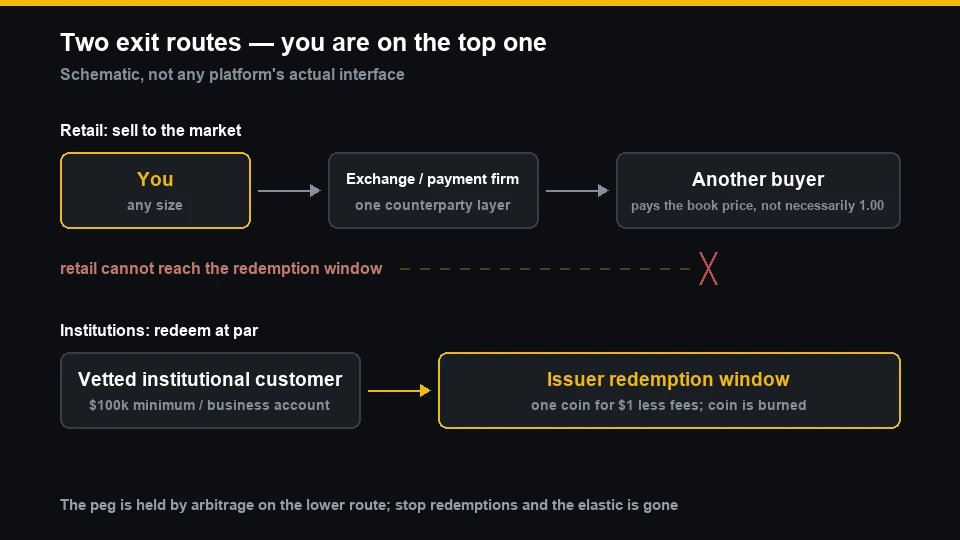
The "sell" button on your exchange is the second column. No part of that transaction involves the issuer; you handed the coin to whoever was willing to take it, at whatever the book was paying. "1 USDT = $1" has never been a promise made to you — it is a market fact that holds most of the time. That distinction is the whole subject of this page.
What the thresholds look like
The terms below come from the issuers' own public pages, checked on 30 August 2026. They can be revised at any point; the current official page governs.
USDT: verified customers, $100,000 minimum
Tether's fee page states a minimum of US$100,000 to issue or redeem tokens directly with the issuer, a redemption fee of the greater of US$1,000 or 0.1%, and an acquisition (minting) fee of 0.1%. Opening a verified account carries a separate 150 USDT verification fee — about US$150 at par — described as non-refundable though creditable against a later redemption.
Put those together. Redeem exactly $100,000 of USDT and the fee is $1,000 — because 0.1% would only be $100, and the terms take the higher figure — so you pay 1%. Smaller amounts are worse in percentage terms, and anything under $100,000 doesn't get through the door at all. That is why the 1:1 in the terms has no practical meaning for a retail holder.
USDC: a Circle Mint account first, and it isn't for individuals
Circle's USDC Terms are blunter about it: converting between USDC and USD directly with Circle requires a Circle Mint account in good standing, and the terms state you may not redeem with Circle unless and until you open one. Circle commits to redeeming 1 USDC for 1 USD — to its Mint customers.
Circle's own Mint product page is blunter still: it is not available to individuals, who can only reach these assets through a network of providers in the secondary market. The page describes its typical users as exchanges, institutional traders, wallet providers, banks and consumer-app companies, and says every applicant goes through background checks, KYC and sanctions screening. So the retail route back to dollars runs through an exchange, broker or payment provider — at least one layer removed.
Issuers run a wholesale operation: mint and burn in blocks of millions, with counterparties they can actually complete compliance checks on. Retail is handled by exchanges and payment firms. There's nothing wrong with that design. The problem is only that marketing language tends to describe a wholesale-side commitment as if every holder were carrying it in their pocket.
Who actually holds the peg
If virtually no holder can reach the redemption window, why does the price sit on 1.00 year after year?
Because the people who can reach it arbitrage the difference. When the market drops to 0.995, a firm with redemption access buys on the market, redeems at par, and pockets half a cent per coin — and its buying pushes the price back toward the peg. Above 1.005, the trade runs the other way: mint at par, sell into the market, and the selling pressure pulls the price down. The stability you enjoy is a by-product of that loop.
The loop has one obvious single point of failure: redemption has to stay open. If an issuer suspends redemptions, imposes limits, or the custody behind the reserves runs into trouble, the arbitrage can't close and the elastic pulling price back to par is gone.
Which explains something that otherwise looks odd. In what to do when a stablecoin depegs we list "official redemption suspended or capped" as one of the hardest signals there is. You will never personally use that channel — and it still decides whether your coin can be sold near a dollar. Unusable is not the same as unimportant. The full mechanism behind a depeg is broken down in what a depeg is and how to spot one coming.
What this means for you in practice
Four consequences worth carrying around.
1. Your exit price is a market price, not a guaranteed one
Nobody promised you 1.00. It holds because arbitrage works and the book is deep. Under stress both of those can loosen at once, which is exactly why a one-click market sell during a depeg tends to become the second loss of the day.
2. You are carrying an extra counterparty
The retail path is you → an exchange or payment company → and only then the issuer. Every step is a counterparty. Reserves can be in perfect shape and you still can't move if the platform holding your coins halts withdrawals or restricts trading. What to weigh when choosing where to keep them is in USDT on an exchange vs self-custody.
3. Reserve reports still matter — for a different reason
You are not reading them because "if the reserves are there, I can go and redeem." You can't. You read them because the state of the reserves determines whether the firms that can redeem still want to step in, and whether the arbitrage loop survives under pressure. How to open those reports and which four lines to read is in how to read a reserve report yourself.
4. Spreading holdings is more practical than it sounds
Everything in one coin on one platform means a single exit route, not just a single issuer. Diversifying spreads the risk of being unable to move at the worst moment, which is a separate thing from spreading issuer risk. To review your own setup systematically, run the safe-holding checklist.
One exception: the statutory right in the EU
Everything above is commercial terms set by the issuers. There is one place where redemption is a legal obligation rather than a business decision: the European Union.
Under the Markets in Crypto-Assets Regulation (MiCA, Regulation (EU) 2023/1114), Article 49 gives holders of e-money tokens the right to redeem at any time and at par value with the issuer. It is a right held by the holder, institutional or not. For the exact wording, whether fees may be charged and any other conditions, the official EUR-Lex text linked at the end of this page governs — we could not read that page in full with our automated tool on the verification date, so this is a qualitative summary rather than a restatement of the clause.
Two qualifications keep this from being over-read:
- It binds issuers authorised under that regulation to issue e-money tokens in the EU. Not every stablecoin available in Europe falls into that category; whether a specific coin qualifies, and whether it's obtainable where you live, comes down to the issuer's and the local regulator's current position.
- European stablecoin rules have been moving, including how trading venues list particular coins in the EEA. When you find a conclusion in an older article, check its date first. Background is tracked in are stablecoins regulated?
Worth noting too: Circle's USDC Terms themselves state that they apply only to holders located outside the EEA, with holders inside the area covered by a separate white paper. Even the issuers document the fact that the same coin comes with different rights depending on where you stand.
Three claims that stop working
Once redemption is clear, several familiar lines collapse on their own:
- "A stablecoin is a digital dollar you can always cash in." The people who can always cash in are qualified institutions. What you can do is sell to someone else, at the price on offer. In calm markets the two look identical; in stressed ones they are nothing alike.
- "Reserves are 1:1, so the price can't fall below a dollar." Reserves determine whether arbitrageurs are willing to step in and whether the redemption loop closes. They are not a price floor. Coins with real reserves behind them have traded well below par before.
- "Someone can get you a 1:1 redemption through an inside channel." Treat this as a fraud signal, full stop. Redemption procedures are published in the public terms, with specific account and size requirements, and are not arranged by direct message, agents or supposed internal allocations. The related patterns are unpacked in the traps with USDT.
To be clear on scope: this page summarises published terms, predicts nothing about any issuer's condition, and is not investment advice. Terms, fees and regional rules change; check the current official page before acting on any of it.
Primary sources and verification date
Checked 30 August 2026. Terms may change at any time:
- Tether official fee page (verification fee, minimum size, issuance and redemption fees)
- Circle: USDC Terms (redemption eligibility and the Circle Mint account requirement; applies to holders outside the EEA)
- Circle Mint product page (states it is not available to individuals, names the typical user types, and sets out the background-check / KYC / sanctions-screening requirement)
- EU MiCA official text, Regulation (EU) 2023/1114 (Article 49 on redemption of e-money tokens) (the page returned no readable content to our automated tool on the verification date; this article summarises the provision qualitatively and the official text governs)
FAQ
Can I redeem USDT with Tether directly?
Per Tether's official fee page as checked on 30 August 2026, direct redemption is open to verified customers only, with a minimum of US$100,000 per transaction and a redemption fee of the greater of US$1,000 or 0.1%. Getting verified in the first place carries a 150 USDT fee (about US$150 at par), stated as non-refundable but creditable against a later redemption. The process exists and the terms are public — the threshold simply sits outside what almost any retail holder would use. Conditions can change, so the current official page governs.
What about USDC — can an individual redeem with Circle?
Under Circle's USDC Terms, redeeming USDC for USD directly with Circle requires a Circle Mint account in good standing, and the terms state you may not redeem with Circle unless and until you open one. Circle's Mint product page states it is not available to individuals; its typical users are exchanges, institutional traders, wallet providers, banks and consumer-app companies, and applicants go through background checks, KYC and sanctions screening. For a retail holder, the route back to dollars runs through an exchange, broker or payment provider instead. Holders in the European Economic Area fall under the USDC White Paper, which sets different rules.
If I can't redeem, who is holding the price at $1?
The institutions that can reach the redemption window. When the market price drops meaningfully below $1, a firm with redemption access can buy on the market, redeem at par with the issuer and keep the difference; that buying pressure pushes the price back toward the peg, and the reverse trade works above $1. Whether that loop functions depends entirely on redemption staying open. So for a retail holder, the state of a channel you personally cannot use still determines whether your coin can be sold near a dollar.
Are the rules different in the EU?
Under the EU's Markets in Crypto-Assets Regulation (MiCA, Regulation (EU) 2023/1114), Article 49 gives holders of e-money tokens the right to redeem at any time and at par value with the issuer. That is a statutory right and it does not depend on being an institution; for the exact wording and any conditions on fees, the official EUR-Lex text governs and this is a qualitative summary. It binds issuers authorised to issue e-money tokens in the EU under that regulation, so whether any particular coin qualifies, and whether it is available where you live, is determined by the issuer's and the local regulator's current statements — it is not a blanket rule covering every stablecoin.
Does this mean stablecoins are unsafe?
No — it means the risk sits somewhere other than where most people picture it. Your exit is the order book on a trading venue, not the issuer's redemption desk, so what you are actually carrying is market liquidity risk and platform counterparty risk stacked on top of the issuer's reserve risk. Once that is clear, the way you choose where to hold, how you read depeg headlines and whether you spread holdings all change.