Your stablecoin depegged — sell or wait? Triage it in four steps
The first time "1 USDT ≈ $0.968" appears on a price page, most people's hand is already on the sell button. Whether selling is right depends on three things you haven't checked yet.
Why depegs happen and how to spot one building is covered in what a depeg is. This page handles the other half: it has already happened, and the next few hours need an order of operations. The headline is that the first move isn't a trade — it's triage. Get the order wrong and you land in one of two well-documented outcomes: selling near the low of a scare that ends two days later, or holding out for a repeg that never comes. Both have happened. What separated them wasn't nerve; it was which kind of coin was in the wallet.
Step 1: five-minute triage — put it in a tier
Triage does not predict whether a coin will repeg, and it cannot decide “sell or wait” for you. It organises the mechanism, direction of the gap, redemption status and official disclosures into facts you can verify. The three questions below take only a few minutes for a first pass, but the answers must be checked again as announcements and market conditions change.
Question one: which type is it? Fiat-backed coins — cash and short-term government debt behind them, which covers USDT, USDC and FDUSD — and algorithmic or synthetic ones are different animals. For the first group a depeg is a question of whether the assets are there and redemptions are flowing. For the second, the depeg can be the mechanism taking itself apart. If you aren't sure which you hold, the three types are laid out in what a stablecoin is, or run it through the stablecoin risk radar for its mechanism and reserve backing.
Question two: how far, and for how long? $0.999 and $0.97 are not the same event, and ten minutes down is not a day down. Note two things: the current gap, and whether it is narrowing or widening. The direction matters more than the size — a slow, persistent slide is more worrying than a sharp dip that snaps back.
Question three: is there a hard signal? Price is the symptom; hard signals are the cause. Any one of these four changes the nature of the situation:
- Trouble at the issuer or its reserve custodian — a custodian bank failing or being taken over, reserve accounts frozen, the issuer under investigation.
- Redemptions suspended or capped — once "hand it back, get $1" is blocked, the arbitrage that drags the price back to the peg stops working. This is the hardest signal of the four.
- Prolonged silence from the issuer — a full business day with no clear statement is itself information.
- Several major platforms acting at once — more than one venue halting deposits and withdrawals, delisting pairs or changing rules means the concern isn't limited to retail holders.
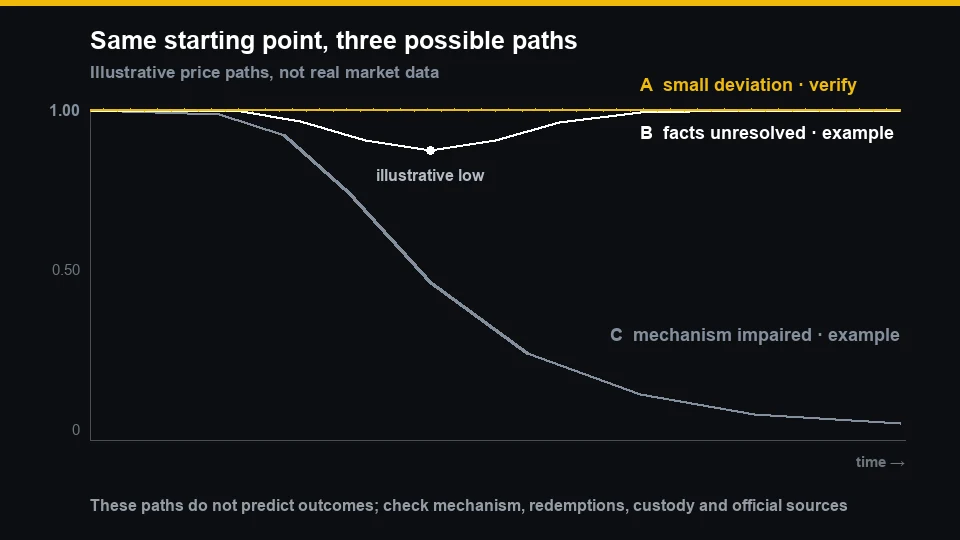
Put the three answers together and you land in one of three tiers:
| Tier | What it looks like | Historical example | What to verify |
|---|---|---|---|
| A · Small deviation | Fiat-backed, limited gap, with no confirmed redemption or custody signal yet | A short-lived deviation can occur during stressed markets | Record the direction; check issuer statements, redemption status and custody disclosures without assuming a repeg |
| B · Facts unresolved | Fiat-backed, widening gap, with at least one redemption, custody or venue-restriction signal | USDC, March 2023: some reserves were held at the closed Silicon Valley Bank | Verify issuer disclosures, regulatory action, redemptions and venue restrictions; assess concentration, liquidity and leverage separately |
| C · Mechanism impaired | An algorithmic or synthetic mechanism is failing, or redemptions have halted and the issuer cannot be reached | UST, May 2022: later SEC material says its price fell close to zero | Confirm the mechanism, counterparties and redemption facts; quantify worst-case loss, leverage and liquidity constraints before choosing a personal response |
These tiers are not “hold, sell or buy the dip” signals, and they do not estimate repeg odds. They only group the facts that need checking by risk state. Two people in the same tier can still have completely different leverage, cash needs, liquidity and loss capacity. The depeg timeline records how past events unfolded, but a historical outcome cannot be pasted onto a different coin.
A fiat-backed peg depends on reserve custody, bank settlement, redemption arrangements and regulatory action, none of which updates on the same clock as a 24-hour market. Silicon Valley Bank was closed on a Friday in March 2023; the US Treasury, Federal Reserve and FDIC issued their joint statement on Sunday, and Circle then updated its USDC reserve and redemption arrangements. That shows information can arrive in stages, not that every weekend depeg will recover. Separate “no new statement yet” from a confirmed hard signal.
Step 2: where the coins sit decides what you can do
With a tier in hand, most people jump straight to "sell or not". One step is still missing: can those coins actually move right now? The same 10,000 USDT sits very differently in five different places.
| Where the coins are | Your real position during a depeg | First thing to do |
|---|---|---|
| Exchange spot account | You can place an order immediately, but depth thins and the spread widens | Read the order book before acting — no one-tap market orders |
| An exchange's earn / savings product | Flexible terms usually redeem, but can queue; fixed terms have a lock-up and early exit follows the product rules | Check the redemption terms on the product page — don't assume instant access |
| Collateral on a margin or futures account | The awkward one: the unit your position is priced in is itself moving, so your margin ratio moves with it | Deal with leverage and liquidation distance first, switching coins second |
| Your own on-chain wallet | Movable, but network fees run higher and confirmations slower in stressed conditions | Price the transfer cost in before deciding to move at all |
| Resting orders / withdrawal under review | In limbo — an unfilled order can still execute at the new price | Cancel the resting orders you no longer want |
The row worth singling out is stablecoins posted as collateral, whether on an exchange's margin account or in a lending position. Normally that's the part of the portfolio that doesn't move; during a depeg it becomes moving ground — the unit of account shifts, position risk shifts with it, and trying to manage a coin switch at the same time usually means doing both badly. The priority there is unambiguous: leverage and liquidation distance first, everything else after.
The other commonly missed row is earn products. Whether money you think of as liquid can actually move, and how quickly, is written into the product terms — not decided by your judgement. Confirming redemption status the moment the news breaks is worth more than refreshing the chart.
One note on placement while we're here: a depeg is exactly the event that exposes the cost of keeping everything in one place — not only concentrated issuer risk, but being unable to act when it counts. Exchange versus self-custody, and what each costs you, is in USDT on an exchange vs self-custody.
Step 3: if you do move, avoid these three second losses
Say triage puts you in tier B or C and you decide to move part of the position. The market during a depeg doesn't behave like the market you're used to, and these three spots are where beginners add a second loss on top of the first.
1. Don't clear the position with a market order
Books thin out and spreads widen, so a market order can fill noticeably worse than the price on your screen — and the bigger the order, the worse it gets. Check the depth, then work a limit order in pieces, accepting "might not fill" in exchange for "won't fill at a number I didn't expect". One-tap convert features deserve the same care: the spread is already inside the quote, so treat it as a real cost and check it before confirming. Rushing the exit is the single most common source of the second loss.
2. Know what you are switching into
"Move into another stablecoin for now" only helps if the other coin is genuinely different. If its reserves sit with the same type of institution, or it leans on the same mechanism, you've changed the name and nothing else — in March 2023, more than one coin was caught in the same bank failure. Real diversification means a different issuer, different reserve custody and a different mechanism, with its own risks acknowledged. Where the three mainstream coins differ on reserves and disclosure is compared in USDT vs USDC vs FDUSD.
And switching into BTC or ETH isn't a safe harbour. You've swapped "might drift a few percent" for "might drop double digits", at a moment when market sentiment is already poor.
3. Don't assume platform rules stay put
Deposit, withdrawal, convert, trading-pair and product-redemption status can all change under stress. Do not infer that a route is open now from an old article, and do not rely on a button merely being visible. Open the venue's current notices and product rules, check the coin, network, account and region that actually apply, then include fees, spread, settlement time and a failed-route fallback in your own plan.
During the 2023 USDC event, Circle disclosed the reserve exposure at Silicon Valley Bank and US regulators later announced how depositors would be treated. In the 2022 UST event, later SEC material records the price falling close to zero after the algorithm failed. The mechanisms, reserves and resolution paths were different, so the cases do not support “wait for every fiat-backed coin” or “sell every algorithmic coin immediately”. The reusable part is the verification order: establish the mechanism, reserves and redemption facts, then apply your own concentration, liquidity and leverage constraints.
Once prices wobble, impersonation follows: "compensation registration", an "emergency swap channel", a support agent messaging you to help move your assets — all asking you to approve a wallet connection or send coins to an address. Two rules hold. Issuers do not DM individuals, and no legitimate "rescue channel" needs your assets transferred out first. The full anatomy of these setups is in the traps that come with holding USDT.
Step 4: doing nothing is also a decision
“Do nothing for now” is not an answer guaranteed by history. It is one scenario that must be written down and checked continuously. Before using it, verify at least these three points; reassess if any one changes:
- you hold a mainstream fiat-backed stablecoin with real assets behind it;
- you don't need this money in the next few days, so you can afford to wait;
- it isn't posted as collateral, and you aren't carrying leverage because of it.
Drop any one of the three and waiting becomes a different proposition — particularly the third. Leverage turns "wait and see" into a bet: adding leverage to bet on a repeg is the fastest way to convert a manageable loss into a ruinous one, in any tier.
"Not acting" isn't "not watching", though. Keep two things in view: whether the issuer has said anything new, and whether redemptions are still running normally. The moment a hard signal appears, the tier has to be reassessed — start again from step one.
After the repeg: treat it as a stress test
The price back near $1.00 doesn't end the story — a repeg means it held this time, not that the original question was answered. While it's fresh, run four questions:
- Why was I holding it? Because I had looked at its reserves and redemption mechanism, or because everyone uses it and it has the most trading pairs?
- Was the position too concentrated? If this had been tier C, what share of my assets would have gone?
- Where were the coins, and could they move? If the answer is "stuck in a redemption queue", that's a placement problem, not a coin problem.
- What's my trigger next time? Writing down "if this hard signal appears, I reduce concentration" beats improvising while the chart is red.
The fourth is worth the few minutes. In the middle of a depeg you are not calm, and a standard written in advance is the only thing that works then. To go through your holding habits systematically, we've put them in a checklist — the safe-holding USDT checklist. To judge whether a particular coin's backing stands up, pair it with is USDT safe and what's actually in Tether's reserves.
One line to close on: the expensive mistake during a depeg is acting before judging. Triage, check where the coins sit, then decide whether to move. Those steps cannot predict the outcome, but they can anchor the decision in verifiable facts and your own risk constraints.
Primary sources and review date
Reviewed on 30 July 2026. These sources document historical events and the verification method; they do not describe the current status of another coin, venue or region:
FAQ
How far does a stablecoin have to fall before I should act?
No single number works for every coin, and price alone cannot predict a repeg. Record whether the gap is widening or narrowing, whether official redemptions are operating, what the issuer and reserve custodian have disclosed, and whether several venues are restricting the coin. A hard signal calls for a fresh review of concentration, liquidity, leverage and your own loss capacity; no hard signal does not guarantee a repeg.
Market order or limit order during a depeg?
Order books thin out during a depeg and spreads widen, so a market order can fill well away from the price you saw — the larger the size, the more obvious it gets. Check the depth first, then work a limit order in smaller pieces. If you use a one-tap convert feature, remember the spread is already baked into the quote; treat it as a real cost and check it before confirming. Rushing to clear a position in one tap is where the second loss usually comes from.
Does switching to another stablecoin make me safe?
It depends on what you switch into. If the new coin's reserves sit with the same kind of institution, or it leans on the same mechanism, you've changed the name and nothing else — when a US bank failed in March 2023, more than one stablecoin was caught up in it. Real diversification means a different issuer, different reserve custody and a different mechanism, while accepting that it carries its own risks. Switching into BTC or ETH isn't a safe harbour either: you've traded a few percent of drift for double-digit volatility.
What if my stablecoin is locked in an earn product?
Check the product's redemption terms first. Flexible products can usually be redeemed at any time, though extreme conditions can put redemptions in a queue; fixed-term products have a lock-up, and whether you can exit early — and on what terms — is set by the platform's current rules. This is the part people overlook: whether money you think of as liquid can actually move, and how fast, is written into the product terms, not decided by your judgement. Confirming redemption status beats refreshing the price chart.
Should I switch back once it repegs?
A repeg means it held this time; it doesn't mean the underlying question went away. Worth asking first: did you pick that coin because you had looked at its reserves and redemption mechanism, or because everyone else uses it? Was the position too concentrated? Do the costs of switching back — fees and spread — justify it? And if you were the one who sold near the low, the more useful review is which judgement step was missing at the time, rather than rushing to restore the position exactly as it was.