Can Tether freeze your USDT? How the blacklist works — and the real risk
There's a function in the USDT contract that lets the issuer block any address it chooses. That's not a rumour — it sits in public code, and anyone can look it up on a block explorer. First reactions come in two flavours — disbelief, then over-correction: "so my USDT could be confiscated at any moment?" Neither matches how the mechanism is actually used.
The short version up front: yes, Tether can freeze USDT — but it freezes addresses tied to law enforcement and sanctions cases, and the odds of an ordinary holder being named are extremely low. The realistic danger for a beginner is different: accepting USDT with a dirty history and getting flagged by association. And one muddle needs clearing first — "my USDT got frozen" covers three different situations, each with its own door to knock on. Mechanism, boundaries, self-protection — one at a time.
How Tether blacklists an address
Start with the mechanism. USDT is a centralised stablecoin, and its issuer, Tether, keeps genuine control over it. The USDT contracts on Ethereum, Tron and the other chains have shipped with a blacklist function from the start: once Tether's administrator keys add an address to that list, the USDT sitting at that address can no longer move. Whoever holds the private key, transfers from a blacklisted address simply fail — including ones signed by the owner.
No need to take anyone's word for it: USDT's contract addresses are public, and a block explorer shows the blacklist functions along with every freeze ever executed. A blacklisted address trying to send USDT isn't slowed down — the transaction never executes.
The powers go further: the same contract lets Tether destroy the USDT at a blacklisted address and issue the same amount afresh. In practice that's used for enforcement recoveries — stolen funds traced to an address get voided and reissued to the victim or the authorities. A freeze isn't only "held in place"; the funds can genuinely be taken off the address.
One misreading to put down here: none of this is a hidden backdoor. The functions sit in public contract code anyone can audit, every freeze leaves an on-chain record, and people watch these calls. The "centralised" in "centralised stablecoin" means precisely this — the issuer keeps the power to intervene. It has been in plain sight all along; most holders just never looked.
Two boundaries. A freeze only touches the USDT at that address — ETH or other tokens in the same wallet are beyond Tether's reach; its authority ends at its own contract. And it isn't unique to USDT: Circle, the issuer of USDC, runs the same kind of blacklist — every fiat-backed centralised stablecoin gives its issuer this switch, so changing coins doesn't dodge it.
One more detail: freezes run per chain and per address — USDT on each chain is a separate contract, so your other addresses aren't automatically swept in. That's no loophole: enforcement requests usually name related addresses together, and hopping wallets to shake a public trail mostly deepens the suspicion.
The switch cuts both ways: your USDT could in theory be frozen, and equally, stolen funds from a hack or scam stand a chance of being stopped before they vanish — some victims have recovered money exactly this way. "On-chain means untouchable" doesn't apply to centralised stablecoins. Whether Tether's reserves hold up is a separate question — covered in is USDT safe.
Three kinds of "freeze" — keep them apart
Before mapping any of that onto yourself: "my USDT got frozen" describes at least three different events — different actor, different thing locked, different door. Work out which one you're looking at:
| Which "freeze" | Who did it | What's locked | Who to go to |
|---|---|---|---|
| On-chain address freeze | Tether (the issuer) | The USDT at that address — on-chain transfers fail | Tether's official process |
| Exchange risk-control hold | The platform's risk systems | Your account functions on that platform (withdrawals, trading) | The platform's support and appeal channels |
| Bank-side freeze | Your bank (it has flagged a fiat transfer) | Fiat in your bank account — nothing to do with USDT itself | Your bank |
Of the three, ordinary users mostly meet the second: a platform hold. A payment that trips a risk rule, unusual activity or a counterparty under investigation can all get account functions limited for a while. None of it involves Tether and the coins are still there — go through the platform's appeal channel, submit what it asks for, and most cases get restored on the platform's timescale. The third kind is a banking matter — your bank flagging a fiat transfer — nothing to do with USDT itself.
Unclear which you've got? Two questions settle it. Where are the coins? USDT inside an exchange account can't be touched by Tether's blacklist — it only bites on-chain addresses, so restrictions inside an account are the platform's doing. And what exactly won't work? Blocked logins, withdrawals or trading point to risk control; coins at your own address refusing to move is the only pattern that might be the blacklist.
Only the first kind is truly "USDT being frozen": coins at your own address, transfers failing outright, the address on Tether's list. The sorting matters because materials sent to the wrong door achieve nothing. Classify first, then act.
Would Tether ever name an ordinary holder?
Look at who Tether actually freezes and the answer writes itself. We've been through its public announcements, and the line is consistent: freezes support law enforcement and sanctions work — requests from courts and regulators, addresses on international sanctions lists, wallets tied to hacks, scams and money laundering. Cumulatively that's thousands of addresses and billions of dollars' worth of USDT, per Tether's own announcements; the exact figures keep moving.
Every entry there has a case behind it. A freeze is a formal step Tether has to own, usually driven by an enforcement or sanctions request; it has neither the incentive nor the bandwidth to trawl ordinary users, and each freeze leaves a public record with people watching. Put bluntly: if you're not the subject of an investigation, the on-chain blacklist is not aimed at you.
But "you won't be named" is not "you have no exposure". The path that actually catches ordinary people is accepting USDT of unknown origin. An on-chain transfer isn't like taking cash — the opposite: every transfer stays publicly traceable, and exchanges and analytics firms label addresses all day long. Once an address touches a case, every later stop the money makes gets tagged too; what looks to you like an ordinary payment can look to a risk engine like "the third hop of case funds". That can end in the table's first row — frozen by association — but far more often the second: a platform hold on your account.
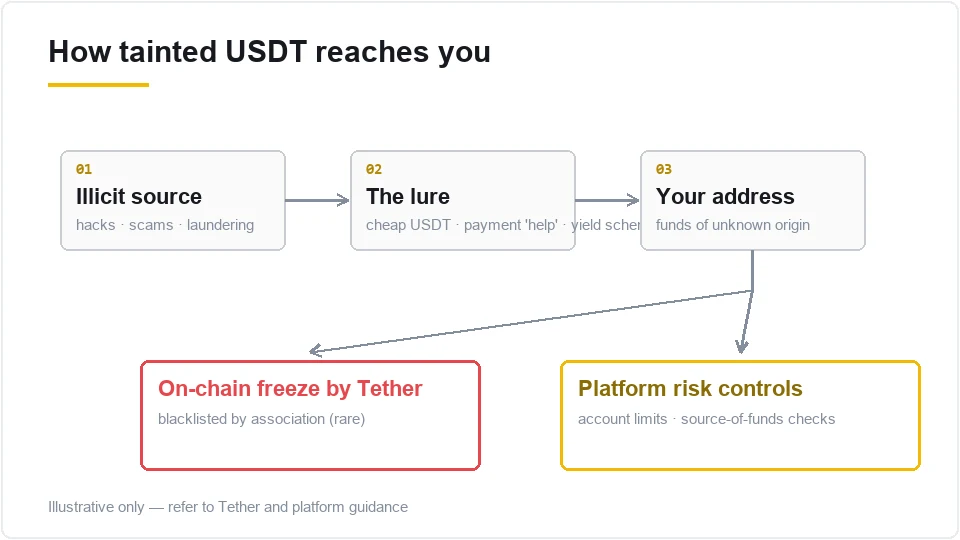
A few scenarios recur. Someone off-platform offers USDT below the market rate — that discount is very often stolen money offloaded at a markdown. Someone asks you to "receive a payment" on their behalf, in and straight out of your address — the worst odds on this page, and in plenty of jurisdictions the act itself creates legal exposure. And high-yield schemes that want USDT sent to a designated address to "start earning" — once it lands, it's mixed with whatever case funds arrived first. We've pulled these apart in the traps that come with holding USDT.
A self-protection checklist for beginners
The whole defence fits in one sentence — control where your USDT comes from and where it goes. In practice:
- Buy on a major platform such as Binance, not off-platform from strangers. On-platform trades pass risk screening and leave a traceable record; a stranger's few points of "discount" aren't worth the association risk.
- Never receive or forward funds for someone else. Whatever the story — an invoice, a salary, "just passing it through" — moving a stranger's USDT through your address is the single riskiest thing on this page. Don't.
- Don't let a yield pitch move your USDT to an unfamiliar address. A legitimate product doesn't need your coins in a stranger's wallet — "transfer it over to start earning" is the doorway to the trap, and once coins leave an address you control, the initiative isn't yours.
- Don't pile everything in one place. Exchange account or self-custody, and what each trade-off costs you — that's covered in USDT on an exchange vs self-custody.
- Already received USDT you're unsure about? Don't rush to move it on. The trail is already on-chain, and shuffling funds just makes it harder to explain. Keep the records and set out the source honestly if the platform asks.
- Hit an actual "freeze"? Sort it against the table first. On-chain freezes go through Tether's official process, platform holds through the platform's appeal channel — have your source-of-funds evidence ready. Whether funds come back, and when, is the handler's call; nobody can promise the outcome.
One breed of scammer targets exactly the people whose funds have just been locked, posing as Tether support or an "unfreezing agent" who can release the money for a fee. Legitimate handling only runs through official channels — paid private unfreezing does not exist. Frozen once, scammed twice is a real pattern.
For a routine check of your own holding habits, run through our safe-holding USDT checklist — it takes a few minutes.
Which brings it back to where your USDT comes from. For a beginner, an on-platform purchase generally leaves more records to check than a stranger's off-platform transfer. If you do not have an account, start with the full sign-up and buying walkthrough, then verify regional availability, KYC requirements and current costs on the official page:
To close: Tether's freeze is real, but it's aimed at cases; your job is to manage where your USDT comes from and keep the three kinds of freeze apart. Do that, and "frozen" most likely stays something you only read about.
FAQ
Will Tether freeze my USDT out of nowhere?
Extremely unlikely. Tether's freezes support law enforcement and sanctions work: requests from courts and regulators, addresses on international sanctions lists, and wallets tied to hacks, scams and money laundering. Ordinary holders aren't the target. For a beginner, the realistic risk isn't being named by Tether — it's accepting USDT with a tainted history and getting flagged by association.
Can frozen USDT be unfrozen?
Work out which kind of freeze it is first. An address blacklisted by Tether goes through Tether's own process; an exchange account under a risk-control hold goes through the platform's appeal channel; a bank-side freeze is a fiat matter you take up with your bank. Whether funds come back, and how long it takes, is the handler's call under their process — nobody can guarantee the outcome, and anyone claiming they can unfreeze it for a fee is a scammer.
If I switch to USDC, can it still be frozen?
Yes. Circle, the issuer of USDC, runs the same kind of blacklist and uses it in much the same way. Any fiat-backed centralised stablecoin gives its issuer this power — it's both a censorship risk and the reason stolen funds can sometimes be intercepted and returned. Changing coins doesn't remove it.
Is it risky to accept USDT from a stranger?
It can be. If the funds upstream are stolen, the on-chain trail leads straight to you: at best a platform asks you to explain where the money came from, at worst your address gets frozen by association. Below-market off-platform deals and 'receiving payments' for someone else both sit in this category. Don't accept USDT you can't account for; if you already have, keep your records and cooperate with the platform's checks.